Key Highlights:
- Deal signals intensifying race for AI infrastructure dominance and memory supply control.
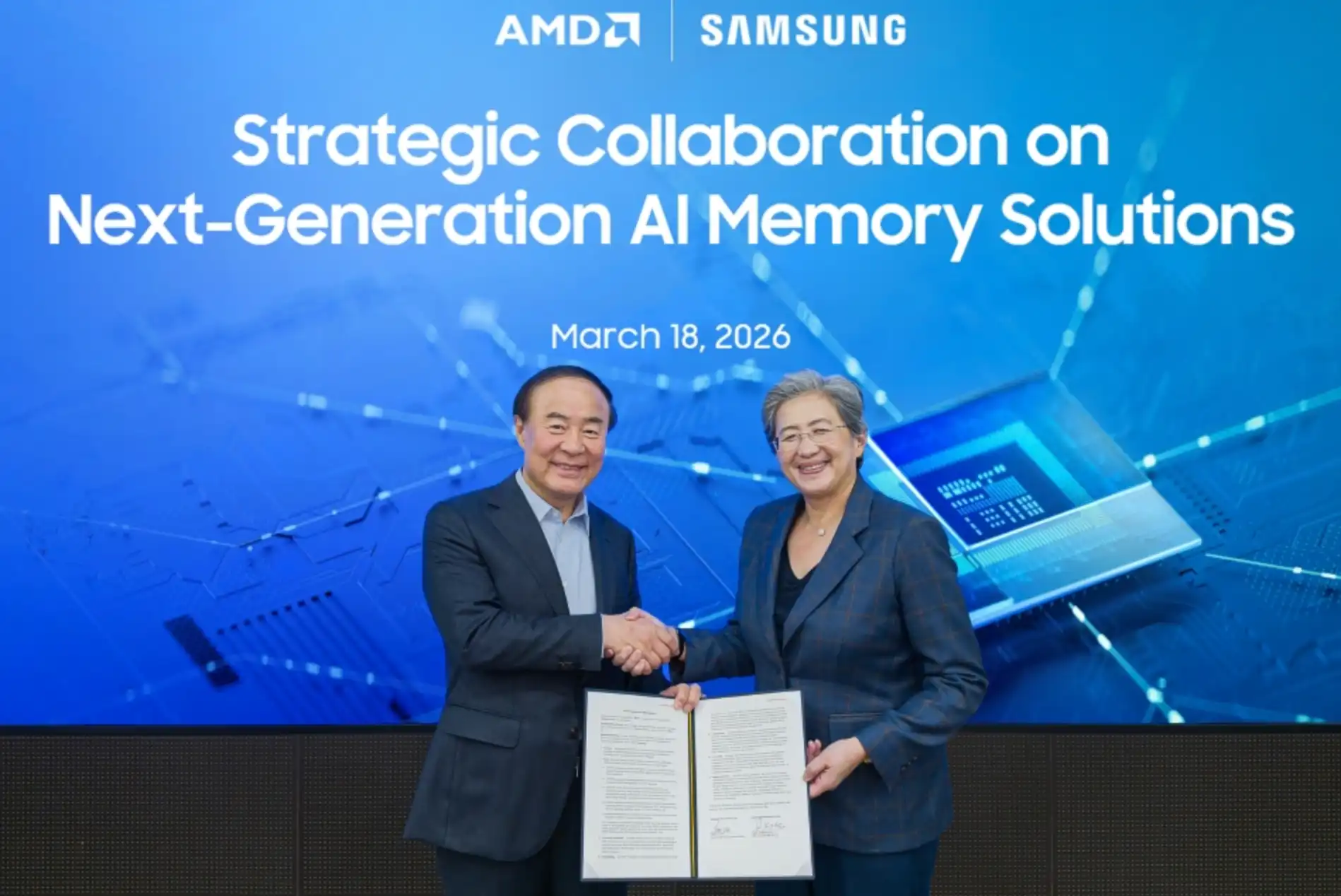
- Samsung Electronics and AMD sign MoU to expand AI memory partnership.
- Focus on next-gen HBM4 memory for AMD’s upcoming Instinct MI455X AI accelerators.
- Companies also explore a potential foundry partnership for future chip manufacturing.
Samsung Electronics has signed a memorandum of understanding with AMD to expand their partnership in AI memory and chip manufacturing. The agreement focuses on supplying next-generation high-bandwidth memory (HBM4) and exploring a potential foundry collaboration.
This move places Samsung Electronics at the center of the growing AI infrastructure race. It also strengthens AMD’s supply chain for its upcoming AI accelerators and processors.
What does the Samsung Electronics–AMD agreement include?
The MoU outlines two core areas of collaboration. First, Samsung Electronics will supply its next-generation HBM4 memory chips for AMD’s upcoming Instinct MI455X AI accelerators. These chips are critical for handling large AI workloads efficiently.
Second, Samsung will provide optimized DDR5 memory for AMD’s sixth-generation EPYC processors. These processors are widely used in data centers and enterprise environments.
Together, these components aim to improve performance in AI training, inference, and cloud computing systems.
Why is HBM4 memory critical for AI infrastructure?
High-bandwidth memory, or HBM, has become essential for modern AI systems. It allows faster data transfer between memory and processors, which is key for handling large models.
HBM4 is expected to deliver higher bandwidth and better efficiency than previous generations like HBM3E. This makes it suitable for next-gen AI accelerators, including AMD’s upcoming chips.
Samsung Electronics has already been supplying HBM3E for AMD’s MI350X and MI355X accelerators. With HBM4, the company is aiming to strengthen its position in this fast-growing segment.
Could Samsung Electronics become AMD’s foundry partner?
Beyond memory supply, the agreement opens the door for a deeper collaboration. The two companies will explore a foundry partnership, where Samsung could manufacture future AMD chips.
This is significant because AMD currently relies heavily on third-party manufacturers. A partnership with Samsung Electronics could diversify its production strategy.
For Samsung, this presents an opportunity to expand its foundry business and compete more directly with other contract chipmakers.
How does this fit into the global AI chip race?
The timing of the deal is notable. It comes during the same week as Nvidia GTC, where Jensen Huang highlighted the importance of memory and announced related partnerships.
The semiconductor industry is currently facing intense competition to secure long-term supply of advanced memory. AI demand has significantly increased the need for HBM chips, creating supply constraints.
This partnership between Samsung Electronics and AMD reflects a broader trend. Chipmakers are locking in strategic agreements to ensure stable access to critical components.
Where does Samsung stand in the HBM market?
Samsung Electronics is the world’s largest memory chipmaker. However, it is still catching up in the HBM segment.
The company holds around 22% of the global HBM market. In comparison, its main rival SK Hynix leads with about 57%.
By partnering with AMD and focusing on HBM4, Samsung aims to narrow this gap. Securing long-term supply deals could help improve its position in the market.
How does this connect to AMD’s larger AI ambitions?
AMD has been aggressively expanding its presence in the AI chip market. The company recently signed major deals to supply AI chips to large tech firms.
For instance, AMD has agreed to supply up to $60 billion worth of AI chips to Meta Platforms over five years. It has also partnered with OpenAI.
These deals increase the demand for reliable memory supply. That makes partnerships like the one with Samsung Electronics even more important.
What does this mean for the semiconductor industry?
This agreement highlights a shift in how semiconductor companies operate. Instead of isolated supply chains, companies are forming deeper, long-term partnerships.
AI demand is reshaping priorities. Memory is no longer a secondary component. It is now central to performance and scalability.
As a result, collaborations between memory makers and chip designers are becoming more strategic and essential.
Conclusion
The partnership between Samsung Electronics and AMD signals a critical step in the evolving AI hardware ecosystem. By focusing on HBM4 and exploring foundry collaboration, Samsung Electronics is positioning itself as a key player in next-generation AI infrastructure.