Key Highlights:
- Amazon has introduced three personality styles for Alexa+, allowing users to control how the assistant sounds and responds.
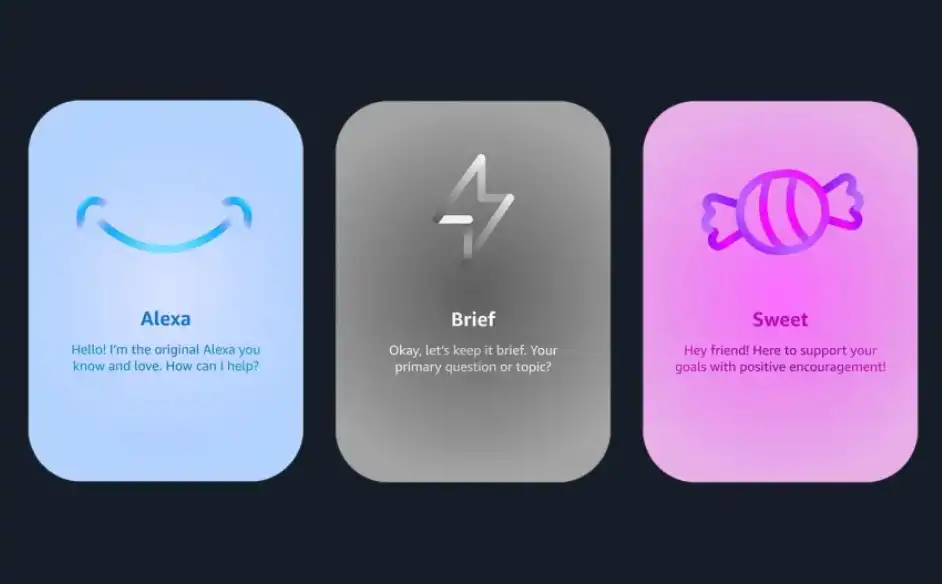
- The new styles are called Brief, Chill, and Sweet, each changing tone, humor, and emotional warmth.
- Users can switch personalities through voice commands or the Alexa app.
- The feature is currently limited to the U.S., with more styles planned later.
Amazon has rolled out a new update for Alexa+, its AI-powered voice assistant, introducing personality options that let users control how the assistant responds. The company announced three personality styles — Brief, Chill, and Sweet — designed to change Alexa+’s tone, emotional warmth, and conversational style.
The feature gives users direct control over how Alexa+ sounds, whether they want short answers, casual conversation, or warmer encouragement. The rollout reflects a broader shift in AI design, where users increasingly expect assistants to adapt to their preferences rather than behave the same way for everyone.
At launch, the personality styles are available only in the U.S. market.
What exactly are the new Alexa+ personality styles?
Amazon says the new Alexa+ personalities are built around five behavioral dimensions: expressiveness, emotional openness, formality, directness, and humor. Each style applies a specific mix of those traits.
The Brief style focuses on efficiency. Alexa+ responds with short, direct answers. It keeps humor minimal and avoids unnecessary follow-ups. This mode is aimed at users who want quick information without conversation.
The Chill style shifts Alexa+ into a more relaxed tone. Responses feel casual and friendly, similar to talking to a laid-back friend. The assistant still delivers information clearly, but with lighter phrasing and informal language.
The Sweet style makes Alexa+ warmer and more enthusiastic. The assistant offers encouragement, positive reinforcement, and emotionally open responses. Amazon says this mode is designed for users who prefer supportive and upbeat interactions.
Amazon emphasizes that these styles do more than change wording. Each one adjusts how Alexa+ balances emotion, humor, and directness in conversation.
How can users change Alexa+ personality settings?
Users can switch Alexa+ personalities in two ways.
The first option is through voice commands on compatible devices such as Echo speakers. Users can directly ask Alexa to change its personality style.
The second option is through the Alexa mobile app. The setting appears under Device Settings, where users can choose their preferred personality style for Alexa+.
Amazon says the switch happens instantly, without requiring device restarts or software reinstallation.
Why are AI personalities becoming a big issue?
Giving AI assistants a personality has become one of the most debated topics in generative AI design. Developers want assistants to feel natural and helpful, but not emotionally manipulative or overly affirming.
Some AI systems have faced criticism for being too flattering or emotionally reinforcing. In certain cases, overly affirming AI responses have been linked to unhealthy emotional dependence. Multiple lawsuits in the U.S. have alleged that such behavior worsened existing mental health conditions among users.
At the same time, many users actively want more control over how AI responds. They often customize prompts or instructions to adjust tone, friendliness, and emotional intensity.
This tension has pushed companies to offer clearer controls rather than one default personality.
How does this compare with other AI assistants?
Amazon’s move follows similar changes across the AI industry.
OpenAI recently introduced new controls in ChatGPT that allow users to adjust tone, warmth, enthusiasm, and even emoji usage. These tools were designed to give users more influence over how the AI communicates.
However, even with added controls, some users have complained that newer AI models feel overly reassuring by default. That feedback highlights the difficulty of balancing empathy with neutrality.
Amazon says its approach with Alexa+ focuses on predefined personality frameworks rather than open-ended customization. Each style uses specific levels of the five personality dimensions to maintain predictability.
What does this mean for everyday users?
For users, the update changes how Alexa+ fits into daily routines.
Those using Alexa primarily for reminders, timers, or quick facts may prefer the Brief style. Users who treat Alexa as a conversational companion may lean toward Chill or Sweet, depending on preference.
The feature also acknowledges that people interact with voice assistants in different emotional contexts. A single default personality may not work equally well for everyone.
By offering multiple styles, Amazon allows users to set boundaries around how expressive or emotional Alexa+ becomes.
Where is personality features available right now?
Amazon says the personality styles are currently limited to the U.S. The company has not confirmed a timeline for expansion to other regions.
It has also stated that the three styles are only the first wave. Additional personality options are planned for future updates.
The rollout applies specifically to Alexa+, Amazon’s newer AI-enhanced version of Alexa, rather than older versions of the assistant.
The bigger picture for AI assistants
The launch shows how AI assistants are moving away from one-size-fits-all behavior. Instead, companies are focusing on controllable, transparent interaction models.
For Amazon, Alexa+ personality controls are a way to modernize its voice assistant while responding to user expectations and industry scrutiny.
As AI assistants become more integrated into homes and daily life, the ability to choose how they speak may become as standard as choosing notification sounds or privacy settings.
Amazon says it will continue refining Alexa+ personality options as the system evolves.
In the long run, Alexa+ is becoming less about sounding human by default, and more about sounding the way users choose.