Key Highlights
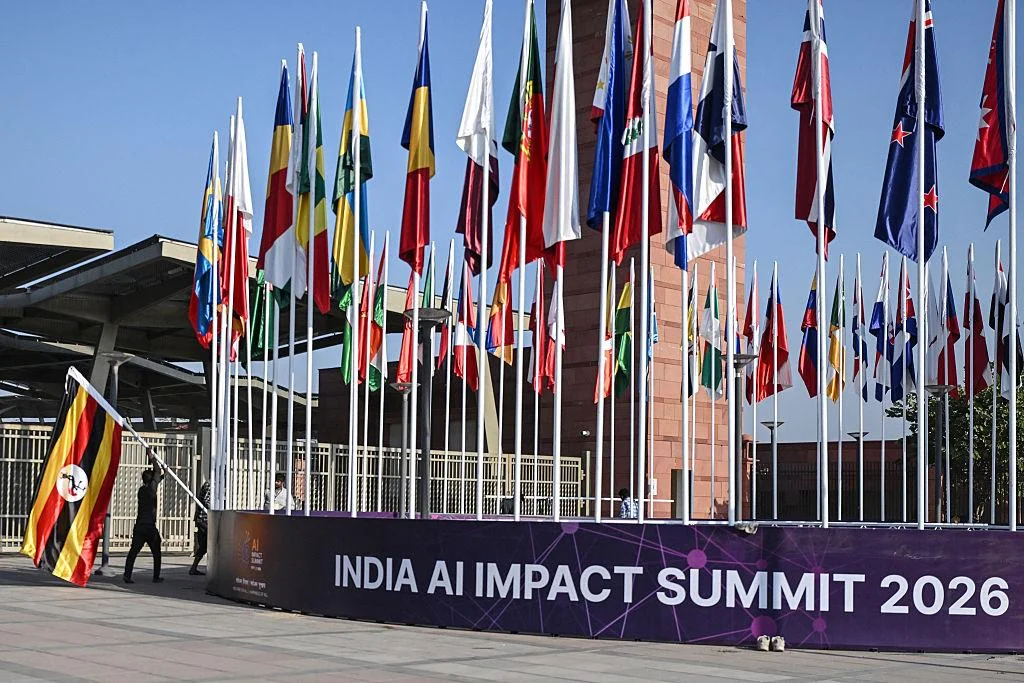
- The declaration was adopted at the AI Impact Summit, held in New Delhi on February 19–20, 2026.
- Nearly 85 countries and three international organisations signed the New Delhi Declaration after extended negotiations.
- Major AI powers, including the United States and China, endorsed the document.
- The statement introduces voluntary frameworks such as the AI Summit Impact Declaration, Global AI Impact Commons, and Trusted AI Commons.
Nearly 85 countries and three international organisations have formally signed the AI Summit Impact Declaration, also known as the New Delhi Declaration, at the AI Impact Summit. The non-binding document lays out shared principles for democratising access to artificial intelligence, strengthening trust and security, and expanding global cooperation on AI development.
The signings concluded a day after the summit officially ended, as organisers worked to broaden consensus and secure participation from major AI stakeholders.
What is the AI Summit Impact Declaration?
The AI Summit Impact Declaration is a voluntary, non-binding global framework aimed at guiding how nations develop, deploy, and govern artificial intelligence. It draws from Indian philosophical principles such as Sarvajan Hitaya, Sarvajan Sukhaya—welfare and happiness for all—and Vasudhaiva Kutumbakam, which views the world as one family.
Rather than imposing rules, the declaration focuses on cooperation, shared learning, and access. It positions AI as a global public good that must benefit all societies, not just advanced economies.
Who signed the declaration?
According to the Indian government, 85 countries and three international organisations are now signatories. The endorsement by both Washington and Beijing gives the declaration added geopolitical weight, especially at a time when global AI governance remains fragmented.
The declaration was signed on the margins of the summit in the presence of Union Minister Ashwini Vaishnaw and Michael Kratsios, Director of the White House Office of Science and Technology Policy.
Why did consensus take longer?
Much like the 2023 G20 negotiations, the road to agreement relied on voluntary commitments. Some countries remained cautious about binding language on AI safety and regulation.
While the declaration does address AI security and trust, it avoids strict enforcement. This softer approach helped bring more countries on board, including those that had resisted stronger language during earlier global AI talks in Paris.
What does the declaration say about democratising AI?
One of the core pillars of the AI Summit Impact Declaration is access. The document recognises that affordable connectivity, digital infrastructure, and foundational AI tools are prerequisites for meaningful AI adoption.
It introduces a Charter for the Democratic Diffusion of AI, described as a voluntary framework to:
- Expand access to foundational AI resources
- Support locally relevant AI innovation
- Build resilient national AI ecosystems
- Respect domestic laws and sovereignty
The goal is to prevent AI development from being concentrated in a handful of countries or corporations.
How does it address economic growth and social good?
The declaration highlights AI’s potential to drive large-scale economic and social development. It encourages the use of open-source AI models and accessible AI systems where appropriate.
To support this, participants took note of the Global AI Impact Commons, a voluntary platform designed to showcase real-world AI use cases. Governments can use the platform to study, replicate, and scale successful AI deployments across sectors and regions.
What about AI safety and trust?
The declaration states that secure, trustworthy, and robust AI systems are foundational for public trust. It acknowledges growing concerns around AI misuse, security risks, and systemic vulnerabilities.
Instead of mandates, it promotes:
- Industry-led voluntary measures
- Technical solutions and benchmarks
- Policy frameworks that balance innovation with public interest
It also references the Trusted AI Commons, a collaborative platform offering shared tools, best practices, and technical resources that countries can adapt locally.
How does science fit into the AI agenda?
The declaration recognises that access to AI research infrastructure remains uneven. Removing structural barriers could significantly accelerate scientific research, especially in developing economies.
To address this, the summit introduced the International Network of AI for Science Institutions, a voluntary collaborative platform. It aims to connect scientific communities, pool AI research capabilities, and speed up the adoption of AI in research and development.
How does AI support social empowerment?
AI is framed as a tool to widen access to knowledge, services, and economic participation. The declaration stresses collaboration to deploy AI solutions that support social empowerment across borders.
Participants acknowledged a new voluntary platform focused on sharing learnings and scalable practices that advance AI adoption for social good.
Why does human capital matter in the declaration?
The declaration places strong emphasis on people. It states that the full promise of AI can only be realised by expanding AI education, workforce training, and public awareness.
It highlights:
- AI literacy initiatives
- Training for public officials
- Workforce development programmes
- Vocational and reskilling ecosystems
Countries also took note of voluntary guiding principles for reskilling in the age of AI and a playbook on AI workforce development.
How does the declaration address energy and infrastructure?
AI’s rising energy and infrastructure demands are directly acknowledged. The declaration underscores the importance of energy-efficient AI systems and resilient digital infrastructure.
It references voluntary guiding principles on resilient and efficient AI, along with a playbook to support sustainable AI infrastructure development.
What happens next?
In its conclusion, the declaration states that the AI Impact Summit will strengthen international cooperation through voluntary guidelines and shared priorities. It commits participants to translating these principles into action under the three Sutras of the India AI Impact Summit 2026.
As a non-binding framework, the AI Summit Impact Declaration does not enforce compliance. Its influence will depend on how countries choose to implement its ideas in national AI strategies.