Key Highlights:
- Creators must disclose synthetic or altered content.
- YouTube will allow creators to generate videos using AI versions of themselves this year.
- The feature mirrors OpenAI Sora’s “cameo” tool.
- Over one million channels already use YouTube’s AI tools daily.
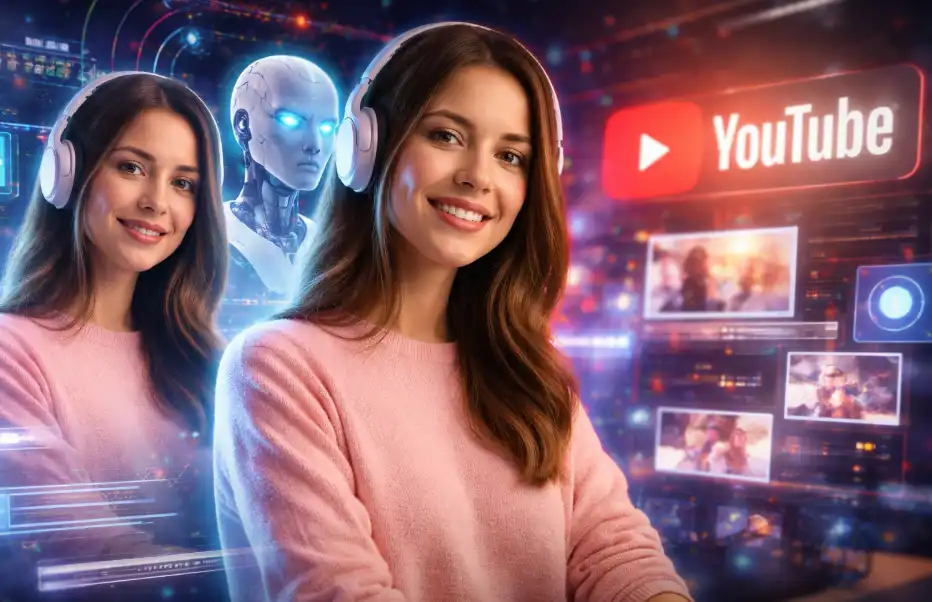
YouTube will soon let creators generate videos using AI versions of themselves. The feature, announced by CEO Neal Mohan, mirrors OpenAI Sora’s cameo tool. It matters because it reshapes how identity, creativity, and trust work on the internet.
The update arrives as AI tools move from novelty to daily production gear. YouTube wants to lead that shift.
What exactly is it building?
The company plans to let creators insert their face and voice into AI-generated videos. Users will be able to create short clips that look and sound like them. The tool follows Sora’s cameo feature, which OpenAI launched last year.
Mohan framed AI as the next big creative leap. He compared it to the music synthesizer and Photoshop. In December alone, more than one million channels used YouTube’s AI tools every day.
The platform also plans to let creators build simple games from text prompts. It signals a broader push to turn YouTube into an AI-native creation hub.
Why is YouTube racing OpenAI?
Google and OpenAI are locked in an AI rivalry. Google is rolling generative AI into Gmail, Maps, and Search. YouTube now becomes another frontline.
Sora showed how fast video creation can change. With AI likeness tools, anyone can appear in scenes they never filmed. YouTube does not want that future to live elsewhere.
By matching Sora, YouTube keeps creators inside its ecosystem.
How will it handle deepfake risks?
YouTube says AI should stay a “tool for expression, not a replacement.” To support that, the platform will:
- Require creators to disclose altered or synthetic content
- Offer tools to manage unauthorized use of likeness
- Expand systems to fight “AI slop,” or low-quality automated videos
The company will adapt its existing anti-spam and clickbait systems to spot mass-produced content.
These steps aim to protect trust while still enabling scale.
What this means for creators and viewers
Creators gain speed. One person can appear everywhere at once. Production costs fall. Formats expand.
Viewers face a new challenge: knowing what is real.
The company already dominates watch time in the US. Shorts now averages 200 billion daily views. Adding AI likeness tools turns YouTube into a factory for synthetic presence.
As YouTube rolls this out, identity becomes software. The platform insists humans stay in control. The real test will be whether YouTube can keep creativity human in an age of perfect digital copies.