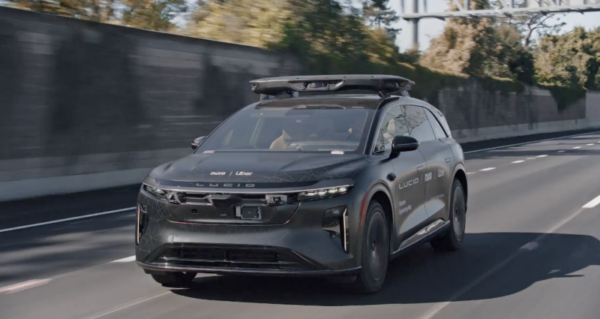
Autonomous On-Road Testing Begins Soon
Uber has officially revealed its next-generation robotaxi at CES 2026, signaling a major step forward in autonomous ride-hailing. The vehicle, developed in partnership with Lucid Motors and autonomous driving firm Nuro, is a production-intent model rather than a concept. Uber confirmed that the robotaxi is already being tested on public roads, with commercial service planned for the San Francisco Bay Area later this year.
The announcement builds on a deal announced last year, under which Uber invested $300 million in Lucid and committed to purchasing 20,000 electric vehicles. The robotaxi showcased at CES represents the most tangible outcome of that collaboration so far.
Built on the Lucid Gravity Electric SUV
The Uber robotaxi is based on the Lucid Gravity SUV, chosen for its spacious interior and premium electric architecture. The vehicle integrates high-resolution cameras, radars, and solid-state lidar sensors directly into its body and roof-mounted halo. This design allows the autonomous hardware to blend seamlessly into the vehicle rather than appearing as an external add-on.
The halo also features integrated LED lighting to help riders identify their vehicle during pickup, a system similar to those used by other autonomous fleets.
Autonomous Tech Powered by Nuro and Nvidia
Nuro supplies the autonomous driving software that enables the robotaxi to operate without a human driver. The system is powered by Nvidia’s Drive AGX Thor computer, which processes large volumes of sensor data in real time. This setup allows the vehicle to navigate complex urban environments while responding to pedestrians, traffic, and road conditions.
Unlike some competitors, Lucid installs the full autonomy package during vehicle production at its Arizona factory. This approach reduces manufacturing complexity and speeds up deployment at scale.
Inside the Uber Robotaxi Experience
Uber has developed a rider-focused digital interface designed specifically for autonomous trips. Rear passengers get a dedicated screen that shows a live animated view of the vehicle moving through city streets. The display also provides estimated arrival time, remaining ride duration, and nearby traffic visualization.
Riders can control climate and audio settings, contact support, or request the vehicle to pull over safely. The front passenger display mirrors much of this information on Lucid’s large curved OLED screen, creating a consistent in-cabin experience.
Launch Plans and What Comes Next
Uber plans to introduce the robotaxi as a premium service. While Lucid faced software challenges during the Gravity’s early rollout, the company says production stability has improved. Final validation of the robotaxi is expected later this year, followed by full-scale production at Lucid’s Arizona facility.
With testing already underway, Uber’s robotaxi is moving from development to deployment.