Key Highlights:
- India formally joins the Pax Silica coalition at the India AI Impact Summit 2026.
- Semiconductor talent, supply chains, and democratic governance sit at the core of the pact.
- The initiative focuses on securing the global silicon and AI technology stack.
- The move deepens strategic technology cooperation between India and the United States.
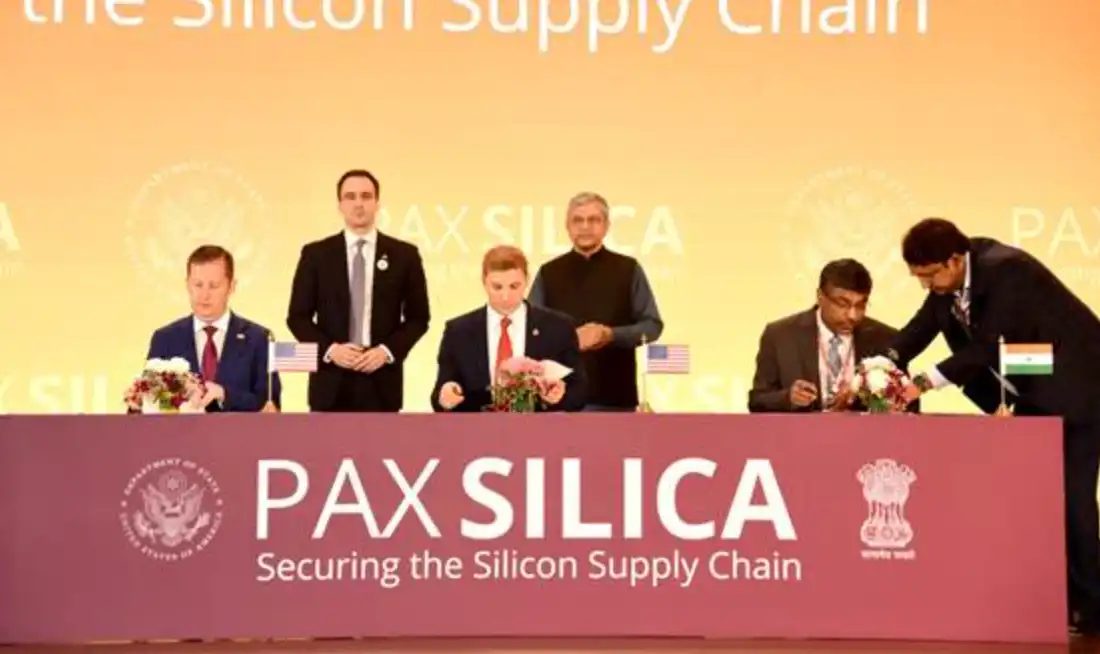
India has formally joined the Pax Silica coalition at the India AI Impact Summit 2026, marking a major step in strengthening strategic technology and supply chain cooperation with the United States. The announcement was made during a high-level signing ceremony attended by senior leaders from both countries.
The move positions India as a key partner in a global effort to secure the silicon and AI technology stack that underpins the modern digital economy.
What is Pax Silica and why does it matter?
Pax Silica is a strategic initiative led by trusted democratic nations. Its goal is to secure and govern the full “silicon stack.” This includes critical minerals, semiconductor manufacturing, advanced chips, AI systems, and deployment infrastructure.
The coalition aims to reduce overconcentration in global supply chains. It also seeks to prevent economic coercion and technology blackmail. At its core, Pax Silica is about ensuring that emerging technologies remain shaped by open and democratic societies.
As AI adoption accelerates worldwide, control over chips and compute infrastructure has become a matter of national security. Pax Silica treats economic security and technology resilience as inseparable.
Why India’s entry is a strategic signal
India’s decision to join Pax Silica sends a clear geopolitical message. The country is no longer only a technology market. It is positioning itself as a builder, designer, and long-term stakeholder in the global technology order.
Speaking at the summit, Union Minister for Electronics and Information Technology Ashwini Vaishnaw framed the moment as future-defining rather than symbolic. He said the summit was about building foundations for the next generation.
Highlighting India’s compounding growth since Independence, he also pointed to India’s role in designing advanced two-nanometer chips. According to him, the semiconductor industry will need nearly one million skilled professionals, creating a major opportunity for India’s workforce.
This emphasis aligns India’s demographic advantage with global semiconductor demand.
How the United States views the partnership
From the US side, officials stressed that Pax Silica is not a routine agreement. Jacob Helberg, United States Under Secretary of State for Economic Growth, Energy, and the Environment, described the declaration as a roadmap for a shared future.
He said the initiative rejects weaponized dependency and economic blackmail. He also underscored that economic security is now national security. According to him, Pax Silica secures everything from minerals underground to AI systems shaping human potential.
The message was clear. The future will be built by those who control and responsibly govern the technology stack.
Why democratic governance of technology is central
US Ambassador to India Sergio Gor described India’s entry as strategic and essential. He said Pax Silica is designed to define the 21st-century economic and technological order.
He emphasized that the initiative covers the entire journey. This starts from critical mineral extraction and extends to chip fabrication and AI data centers. According to him, the coalition is about whether free societies will control the commanding heights of the global economy.
The repeated focus on democratic values highlights that Pax Silica is not only about hardware. It is also about governance, trust, and long-term resilience.
How AI and semiconductors converge in India’s strategy
Following the signing, a high-level fireside chat reinforced the link between AI ambition and semiconductor resilience. The discussion featured leaders from government and industry.
Shri S. Krishnan, Secretary at MeitY, said India’s goal is resilient collaboration with trusted partners. He highlighted coordination across AI, semiconductors, and critical minerals.
Industry leaders echoed the urgency. Sanjay Mehrotra, CEO of Micron Technology, described the effort as a shared commitment to secure supply chains. He called it a win-win ecosystem to advance AI responsibly.
Randhir Thakur, CEO and MD of Tata Electronics, said Pax Silica is timely. He noted that the semiconductor journey has always depended on materials, innovation, and compute.
Together, the statements underline a shift from isolated initiatives to integrated strategy.
What this means for India’s global tech position
India’s participation in Pax Silica reflects a broader transition. The country is moving from being a service-led technology player to a full-stack partner. This includes chip design, manufacturing, AI deployment, and talent development.
It also strengthens India’s role in shaping global norms around technology governance. As AI becomes embedded across economies, such influence carries long-term weight.
For global supply chains, India’s entry adds diversification and scale. For geopolitics, it reinforces alignment between democratic partners on critical technologies.
The bigger picture going forward
The India AI Impact Summit 2026 made one thing clear. The future of AI and advanced technologies will not be left to chance. Countries are actively shaping alliances to secure infrastructure, talent, and values.
India joining Pax Silica reflects that reality. It anchors India more firmly within a trusted technology ecosystem while responding to the pressures of a fragmented global supply chain.
As AI adoption deepens worldwide, such partnerships will define who builds, who governs, and who benefits. In that context, India has signaled it wants a seat at the table, not just as a participant, but as a co-architect of the future.