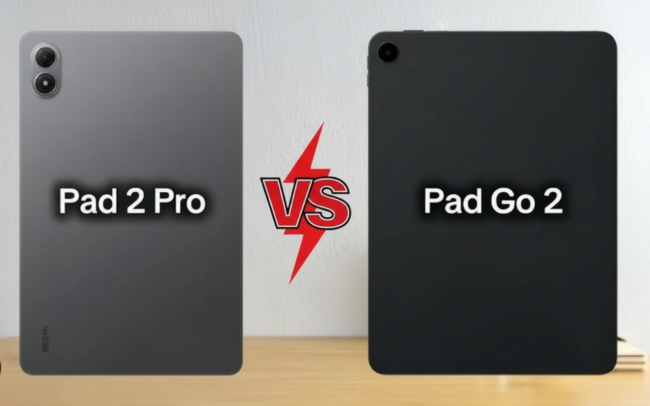
India’s Android tablet market has moved beyond basic 10-inch slates, and the latest proof is a pair of big-screen 12.1-inch contenders: the OnePlus Pad Go 2 and Redmi Pad 2 Pro. Both promise immersive entertainment, productivity-friendly displays, and 5G-ready hardware at mid-range prices, making them obvious picks for buyers upgrading from compact tablets or large phones.
Price and Availability
The OnePlus Pad Go 2 comes in multiple variants:
- 8GB RAM + 128GB (Wi-Fi): ~₹26,999
- 8GB RAM + 256GB (5G): ~₹31,999–₹32,999
It is available via OnePlus.in, Amazon, Flipkart, and offline retailers like Croma and Reliance Digital.
The Redmi Pad 2 Pro 5G is teased for India at an expected ~₹25,000–₹30,000 for base 5G configs, with Wi-Fi models slightly lower. It will launch on Amazon, Flipkart, and Xiaomi outlets in fresh color options like sleek grays and blues.
Design and Build
OnePlus brings its premium tablet DNA to the Pad Go 2. With a slim metal body, curved edges, and a centered camera module, it weighs around 550g and feels modern for desks or couches. It supports stylus and offers IP52-like durability in select markets.
The Redmi Pad 2 Pro, meanwhile, opts for an aluminum unibody with flat sides and a minimal 7.5mm profile. At ~540g, it’s slightly lighter with a matte finish (fingerprint-prone) and emphasizes keyboard/stylus accessories for a laptop-like vibe.
Display Experience
Both tablets feature 12.1-inch LCD displays with high resolutions, making them ideal for streaming and multitasking.
The OnePlus Pad Go 2 offers a 2.8K panel at 90Hz refresh, 500+ nits brightness, and TÜV eye comfort certification. Colors pop vividly indoors, enhanced by quad Dolby Atmos speakers.
The Redmi Pad 2 Pro pushes a 2.5K display with 120Hz smoothness. It hits higher brightness for outdoors but can wash out in direct sun. The panel shines for stylus work and sharp content viewing.
Software and User Experience
Software defines long-term appeal.
The OnePlus Pad Go 2 ships with OxygenOS 16 on Android 16. Clean, fluid, and bloat-free, it excels in split-screen, floating apps, and OnePlus ecosystem sync, with strong update promises.
The Redmi Pad 2 Pro runs HyperOS 2 on Android 15. It supports advanced multitasking, AI tools like Circle to Search, and seamless Xiaomi device integration—smooth but with optional extras.
Performance and Gaming
Both rely on capable mid-range chipsets.
The OnePlus Pad Go 2 uses MediaTek Dimensity 7300-series (5G), handling streaming, browsing, and light gaming smoothly with up to 8GB RAM. High-end titles run playable but not maxed.
The Redmi Pad 2 Pro leverages Snapdragon 7s Gen 4 for a GPU/CPU edge. Everyday tasks fly, heavier games stay stable longer, and multitasking feels snappier in benchmarks.
Battery and Charging
Battery endurance matters for all-day use.
The OnePlus Pad Go 2 packs a 10,050mAh battery with 33W SUPERVOOC charging. It lasts a full day of mixed use, recharging in under 2 hours.
The Redmi Pad 2 Pro has a 10,000mAh battery rated for 18+ hours of video. Charging hits ~33W but takes slightly longer; efficiency shines for media marathons.
Camera Setup
Cameras suit calls and scans.
The OnePlus Pad Go 2 features 8MP rear and 8MP front sensors for clear video calls and basic shots, with AI tweaks but no advanced scanning.
The Redmi Pad 2 Pro matches with 8MP rear/5MP front, better for daylight docs but average in low light. Front cams handle meetings adequately.
Verdict: Which Mid-Range Tablet Wins?
The OnePlus Pad Go 2 nails refined design, fast charging, Dolby audio, and instant availability—perfect for OxygenOS fans and quick buyers.
The Redmi Pad 2 Pro counters with smoother 120Hz display, Snapdragon power, and accessory focus, ideal for Xiaomi users waiting on launch.
OnePlus Pad Go 2 vs Redmi Pad 2 Pro: Compare 12.1-inch displays, Snapdragon vs Dimensity performance, battery life, and prices in India’s mid-range tablet battle. Which 5G tab wins?
Both dominate the 12.1-inch mid-range, but OnePlus wins for now, while Redmi could steal the show post-debut.