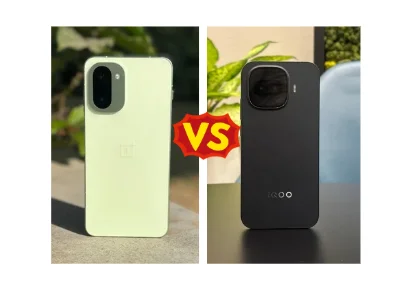
Key Highlights: iQOO 15R vs OnePlus 15R
- Both phones use the Snapdragon 8 Gen 5 chipset
- iQOO 15R offers a larger 7,600mAh battery
- OnePlus 15R delivers higher benchmark performance
- Display refresh rate differs: 144Hz vs 165Hz
- Software experience varies significantly between brands
- Pricing gap remains under ₹3,000 in India
The “R” series now plays a critical role in premium Android smartphones. It bridges the gap between flagship performance and accessible pricing. In this space, the iQOO iQOO 15R, starting at ₹44,999, and the OnePlus OnePlus 15R, priced from ₹47,999, are direct rivals.
Both phones promise near-flagship power, large batteries, and modern displays. However, they take noticeably different routes to reach that goal. This iQOO 15R vs OnePlus 15R comparison explains those differences clearly and highlights which phone suits which type of user.
Design approach: Subtle practicality vs Familiar identity
In terms of design, the iQOO 15R and OnePlus 15R follow contrasting philosophies.
The iQOO 15R keeps things restrained. It avoids gaming accents and visual flair. As a result, the phone looks clean and mature. The dual-camera module also distinguishes it from the flagship iQOO 15. Moreover, the glass back adds a premium feel, even though it can feel slightly slippery during use.
The OnePlus 15R, on the other hand, leans heavily on brand consistency. It closely resembles the OnePlus 15 and OnePlus 13s. Because of its larger battery, the phone feels heavier and thicker. Still, the aluminium frame and refined finish give it a solid in-hand feel.
Durability is strong on both devices. The iQOO 15R offers IP68 and IP69 protection. Meanwhile, the OnePlus 15R goes a step further with IP66, IP68, IP69, and IP69K ratings. Additionally, the OnePlus 15R includes a Plus Key for quick actions, which the iQOO 15R does not offer.
Display comparison: Touch precision vs Immersive scale
The display experience plays a major role in the iQOO 15R vs OnePlus 15R decision.
The iQOO 15R features a 1.5K AMOLED display with a 144Hz refresh rate. More importantly, it focuses on touch responsiveness. A 360Hz touch sampling rate improves daily interactions. During gaming, this increases dramatically to 3200Hz instant sampling. Consequently, fast-paced games feel more responsive.
Brightness handling is another highlight. Local peak brightness reaches 5,000 nits. At the same time, the panel can dim down to 1 nit. Features like 4320Hz PWM dimming and Netflix HDR10+ certification further improve comfort and media consumption.
The OnePlus 15R takes a different approach. It uses a larger 6.83-inch LTPO AMOLED panel with adaptive refresh rates up to 165Hz. Because of this, scrolling feels extremely smooth while efficiency improves during static content. In addition, HDR10+, HDR Vivid, and full DCI-P3 support enhance colour accuracy.
In simple terms, the iQOO 15R prioritises touch speed, while the OnePlus 15R prioritises screen size and adaptive smoothness.
Software and AI: Productivity vs Polish
Software experience often decides long-term satisfaction.
The iQOO 15R runs OriginOS 6 based on Android 16. The interface feels modern and responsive. Transitions remain smooth, even under load. AI features here focus on creation and editing. For example, AI Creation assists with rewriting and summarising text. Similarly, AI Captions enable transcription and translation. Image tools like AI Erase and AI Reflection Erase reduce the need for third-party apps.
By contrast, the OnePlus 15R runs OxygenOS 16 based on Android 16. The interface feels cleaner and more predictable. Parallel Processing 2.0 improves multitasking. AI features focus on organisation. Plus Mind stores on-screen content, while Google Gemini integration allows deeper contextual references. As a result, the software feels more refined for everyday productivity.
Performance: Benchmarks vs Real-world balance
Performance is a key reason buyers search for iQOO 15R vs OnePlus 15R.
Both phones use the Snapdragon 8 Gen 5 processor. However, tuning creates a difference. The iQOO 15R delivers smooth daily performance with fast app launches. Still, benchmark scores remain lower than its rival.
In comparison, the OnePlus 15R posts stronger Geekbench and GPU scores. AnTuTu results also favour OnePlus. Because of this, it holds an edge in raw performance metrics.
In real-world usage, though, the gap narrows. Both phones handle multitasking and gaming reliably. The iQOO 15R uses a large vapour chamber and a Supercomputing Chip Q2 for thermal control. Meanwhile, the OnePlus 15R relies on Cryo-Velocity cooling for sustained performance.
Camera systems: Dependable results over versatility
Camera performance remains practical on both phones.
The iQOO 15R uses a dual-camera setup with advanced imaging algorithms. Daylight photos appear sharp and natural. Low-light shots benefit from a dedicated night mode with controlled noise. Portraits show reliable edge detection. Video recording supports 4K at 60fps.
The OnePlus 15R features a 50MP Sony main sensor and an ultra-wide camera. Daylight images retain strong detail. Night photography uses dual-exposure processing. In addition, the front camera supports autofocus. Video recording goes up to 4K at 120fps, offering more flexibility.
Battery life: Endurance clearly favours iQOO
Battery life is where the difference becomes clearer.
The iQOO 15R packs a massive 7,600mAh silicon anode battery. As a result, heavy users can easily get through a full day. Moderate users can stretch usage further. Bypass charging also helps during long gaming sessions.
The OnePlus 15R includes a 7,400mAh battery. Endurance remains excellent. Charging is handled by 80W fast charging, which balances speed and battery health.
Although both phones last long, the iQOO 15R holds a slight advantage due to its larger capacity.
Final comparison verdict: Which phone suits whom
In the iQOO 15R vs OnePlus 15R comparison, a clear pattern emerges.
The OnePlus 15R is the better choice for users who value software polish, higher benchmark performance, and a larger adaptive display. It feels more refined overall and suits those who prioritise long-term UI consistency.
The iQOO 15R, however, stands out for users who want maximum battery life, strong gaming stability, and a slightly lower starting price. Its focus on endurance and touch responsiveness makes it particularly appealing to gamers and heavy users.
In conclusion, the OnePlus 15R emerges as the more balanced all-rounder, while the iQOO 15R is ideal for users who prioritise battery life and gaming over benchmark leadership.