The Budget Tablet Shift in India
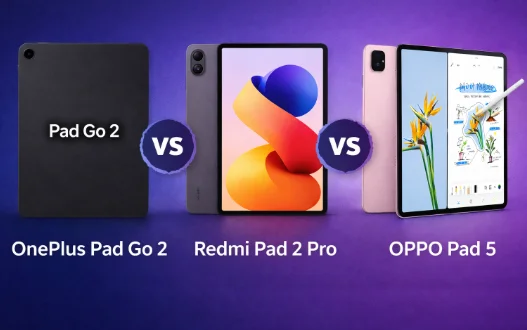
Tablets in India often struggle to find balance. On one side, budget models feel slow. On the other, premium ones cost like laptops. As a result, many buyers search for a middle path. That middle ground now looks crowded. OnePlus Pad Go 2, Redmi Pad 2 Pro, and OPPO Pad 5 target the same audience. Together, they promise large screens, smooth performance, and long battery life. Consequently, students, casual workers, and home users now have real choices. For buyers searching online, however, the question remains simple. Which tablet fits everyday needs better? This comparison explains where each device stands and what separates them.
Design and Build: Practicality vs Elegance
Redmi Pad 2 Pro relies on a metal alloy body that feels dense and sturdy. Moreover, the matte finish resists fingerprints and keeps the surface clean. Xiaomi also adds an IP53 rating, offering limited dust and splash protection.
By contrast, OPPO Pad 5 follows a slim and polished design. It comes in Aurora Pink and Starlight Black. While the tablet feels modern and light, OPPO does not list any formal splash resistance.
Meanwhile, OnePlus Pad Go 2 keeps a familiar look. It grows larger with a 12.1-inch screen and weighs 597 grams. Despite this, it remains manageable during long sessions. OnePlus offers Lavender Drift and Shadow Black, both with a soft, smudge-resistant finish.
All three feel refined. Still, durability matters for daily use.
Winner: Redmi Pad 2 Pro, for its metal body and IP53 protection.
Display: Large Screens, Different Strengths
Redmi Pad 2 Pro features a 12.1-inch LCD with 2.5K resolution and a 120Hz refresh rate. Moreover, it supports Dolby Vision for richer streaming output. Brightness reaches 600 nits, which suits indoor use well.
By contrast, OPPO Pad 5 also uses a 12.1-inch LCD but offers a sharper 2.8K resolution. Additionally, peak brightness climbs to 900 nits, making it easier to view in bright rooms.
Meanwhile, OnePlus Pad Go 2 matches the size with a 2.8K panel and Dolby Vision. However, its reflective glass reduces outdoor clarity.
All three screens suit reading, streaming, and split-screen work. Still, brightness plays a key role in comfort.
Winner: OPPO Pad 5, for higher brightness and visual clarity.
Software Experience: Finally Tablet-First
On Redmi Pad 2 Pro, Android 15 with HyperOS 2 feels adapted for large screens. Multitasking works naturally. Floating windows remain smooth. Additionally, Circle to Search speeds up research.
OPPO Pad 5 runs ColorOS 16 based on Android 16. Here, the interface feels clean and stable. Animations stay smooth, while gestures adapt well to a wider display.
OnePlus Pad Go 2 ships with OxygenOS 16. It feels well optimised for tablets. Split screen and floating windows work reliably. AI tools assist with writing and summaries.
Across all three, large screens finally feel respected. None behaves like a stretched phone.
Winner: Tie, as all three deliver modern tablet-focused software.
Performance: Everyday Speed and Stability
Redmi Pad 2 Pro uses the Snapdragon 7s Gen 4 chipset. As a result, apps open quickly. Multitasking remains fluid. Even gaming runs smoothly with controlled heat.
By contrast, OPPO Pad 5 relies on the Dimensity 7300 Ultra chipset. Daily tasks run well. However, heavy workloads feel slower under pressure.
OnePlus Pad Go 2 also uses the Dimensity 7300 Ultra. Instead of chasing raw speed, it focuses on sustained performance. Consequently, it throttles less during long sessions and stays stable during calls.
All three handle daily work easily. Still, the Redmi feels more confident under load.
Winner: Redmi Pad 2 Pro, for stronger sustained performance.
Cameras: Built for Utility
Each tablet offers an 8MP rear camera for document scans. Every model includes an 8MP front camera for video calls. All support 1080p video.
In practice, results remain similar across devices. They suit classes and meetings. None targets creative photography.
Winner: Tie, as all three meet practical needs equally.
Battery and Charging: Endurance vs Speed
Redmi Pad 2 Pro packs a 12,000mAh battery. Heavy use lasts over a full day. With moderate use, it stretches into two days. It also supports 27W charging and reverse charging.
OPPO Pad 5 carries a 10,050mAh battery. It supports 33W fast charging, which suits short breaks and quick top-ups.
OnePlus Pad Go 2 includes a 10,050mAh battery as well. It lasts through a full day easily. Charging reaches 33W but still takes time.
Endurance favors Redmi. Charging speed favors OPPO.
Battery Winner: Redmi Pad 2 Pro, for longer endurance.
Charging Winner: OPPO Pad 5, for faster refills.
Productivity Potential
Redmi Pad 2 Pro supports a Smart Pen and keyboard case. As a result, long work sessions feel more relaxed.
OPPO Pad 5 supports accessories and multitasking. Therefore, it suits light productivity and reading.
OnePlus Pad Go 2 supports a responsive stylus and adds AI writing tools. However, it lacks an official keyboard.
All three handle basic productivity. Still, balance matters for daily work.
Winner: Redmi Pad 2 Pro, for better balance of power and endurance.
Final Winner: Best Budget Tablet in India
Each tablet serves a different priority.
OnePlus Pad Go 2 focuses on stability, software polish, and reliable battery life.
OPPO Pad 5 highlights display quality and faster charging.
Redmi Pad 2 Pro balances durability, performance, and endurance at a lower starting price.
For buyers searching for the best budget tablet in India, overall balance matters most.
Final Winner: Redmi Pad 2 Pro.