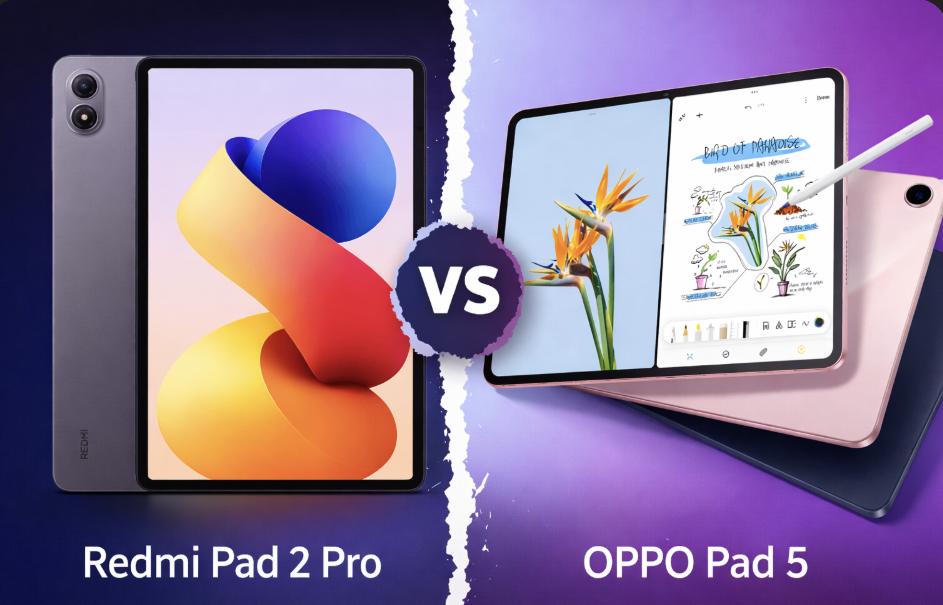
Addressing The Feature-Rich Budget Tablet Gap in India
Tablets in India have long struggled to find their place. Affordable options often feel limited, while premium models drift into laptop territory. Many buyers want something in between. They want a large screen, smooth performance, and reliable battery life without overspending. That middle ground is now getting crowded. Xiaomi’s Redmi Pad 2 Pro and OPPO’s new Pad 5 arrive with similar ambitions. Both target students, professionals, and everyday users who need more than a media screen. Each promises a “budget tablet” that can handle real tasks.
The Redmi Pad 2 Pro starts at ₹22,999 for the Wi-Fi model with 8GB RAM and 128GB storage. The 5G version costs ₹25,999. The top 8GB + 256GB 5G variant sells for ₹27,999.
The OPPO Pad 5 starts at ₹26,999 for Wi-Fi. The Wi-Fi + 5G model costs ₹32,999. OPPO offers one configuration with 8GB RAM and 256GB storage.
With prices staying close and features overlapping, the choice is no longer simple. For anyone searching for the best budget tablet in India, this comparison explains what separates the Redmi Pad 2 Pro from the OPPO Pad 5.
Design and Build: Practical vs Polished
The Redmi Pad 2 Pro uses a metal alloy body that feels dense and sturdy. The matte finish resists fingerprints and keeps the tablet looking clean. Xiaomi also adds an IP53 rating, offering limited protection against dust and splashes. That is rare in this price segment and makes it feel more work-ready.
The OPPO Pad 5 focuses on elegance. It comes in Aurora Pink and Starlight Black. The build feels slim and modern, but OPPO does not list any formal splash resistance.
Both tablets look refined. However, the Redmi’s durability edge makes a real difference for daily use.
Winner: Redmi Pad 2 Pro, for its metal body and IP53 protection.
Display: Big Screens, Different Strengths
The Redmi Pad 2 Pro features a 12.1-inch LCD with 2.5K resolution and a 120Hz refresh rate. It supports Dolby Vision and shows 1.07 billion colours. Brightness reaches 600 nits. Text looks sharp, and scrolling feels smooth.
The OPPO Pad 5 also offers a 12.1-inch LCD, but with a higher 2.8K resolution. It reaches up to 900 nits of peak brightness and supports a wide DCI-P3 colour gamut. This helps in bright rooms and outdoor settings.
Both screens suit streaming, reading, and split-screen work. OPPO’s panel stands out for brightness and sharpness.
Winner: OPPO Pad 5, for its brighter and sharper display.
Software Experience: Finally Tablet-First
The Redmi Pad 2 Pro runs Android 15 with HyperOS 2. The interface adapts well to large screens. Split screen and floating windows feel natural. Xiaomi adds Circle to Search and Gemini integration for research and writing.
The OPPO Pad 5 runs ColorOS 16 based on Android 16. It offers a clean interface with smooth animations and stable multitasking. It also arrives with the latest Android version out of the box.
Both tablets now treat large screens seriously. Neither feels like a stretched phone anymore.
Winner: Tie, as both deliver a modern, tablet-focused software experience.
Performance: Daily Use and Beyond
The Redmi Pad 2 Pro uses the Snapdragon 7s Gen 4 chipset. Apps open quickly. Multitasking remains fluid. Heavy use stays stable. Gaming runs smoothly at higher settings with controlled heat.
The OPPO Pad 5 uses the Dimensity 7300 Ultra chipset. It handles daily tasks well, including browsing, streaming, and office apps. Under sustained load, it feels slightly less relaxed.
Both tablets perform well for most users. The Redmi holds better under pressure.
Winner: Redmi Pad 2 Pro, for stronger sustained performance.
Cameras: Built for Utility
Both tablets offer an 8MP rear camera for document scans and an 8MP front camera for video calls. Each supports 1080p video recording. They suit classes, meetings, and casual use.
Neither device targets creative photography. Both meet the practical needs of a tablet.
Winner: Tie, as both deliver the same real-world results.
Battery and Charging: Endurance vs Speed
The Redmi Pad 2 Pro packs a 12,000mAh battery. Heavy use lasts over a full day. Moderate use stretches into two days. It supports 27W charging and reverse charging.
The OPPO Pad 5 includes a 10,050mAh battery with 33W fast charging. It refills quicker and suits short breaks.
Battery Winner: Redmi Pad 2 Pro, for longer endurance. Charging Winner: OPPO Pad 5, for faster top-ups.
Productivity Potential
Both tablets support accessories for work. The Redmi Pad 2 Pro benefits from stronger performance and better endurance. Long writing or study sessions feel more relaxed.
The OPPO Pad 5 offers a clean workspace and smooth interface, but its hardware feels more tuned for light productivity.
For extended use, the Redmi feels more capable.
Winner: Redmi Pad 2 Pro, for a more work-ready experience.
Final Winner: Best Budget Tablet in India
Across design, performance, battery life, and overall value, one tablet stays ahead more often.
The Redmi Pad 2 Pro wins more key segments. It offers a sturdier build, stronger sustained performance, and far longer endurance. It also starts at a lower price, which matters in the budget tablet category.
The OPPO Pad 5 shines with its brighter, sharper display and faster charging. It suits users who prioritise screen quality and a clean, modern look.
Yet for most buyers searching for the best budget tablet in India, the balance of power, battery, durability, and price makes the choice clearer.
Final Winner: Redmi Pad 2 Pro.