Key Highlights
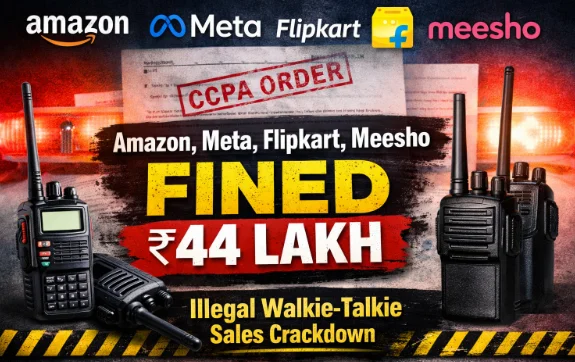
- Amazon, Meta, Flipkart, and Meesho fined ₹10 lakh each by CCPA
- Over 16,970 illegal walkie-talkie listings found across platforms
- Devices violated telecom frequency and certification rules
- New 2025 guidelines issued to prevent illegal radio equipment sales
India’s consumer watchdog has fined Amazon, Meta, Flipkart, and Meesho for illegally selling walkie-talkies online.
The penalties total ₹44 lakh. The case matters because unauthorised radio devices can disrupt critical communication networks.
The Central Consumer Protection Authority acted after finding thousands of non-compliant walkie-talkies listed and sold on major platforms.
What triggered action against Amazon and other platforms?
The Central Consumer Protection Authority launched a suo motu probe after detecting illegal listings of Personal Mobile Radios (PMRs).
In total, 16,970 listings violated telecom and consumer protection rules.
These devices operated outside license-exempt frequencies. Many lacked mandatory Equipment Type Approval (ETA).
As a result, the authority issued final orders against eight entities.
Who was fined and how much?
Amazon, Meta (Facebook Marketplace), Flipkart, and Meesho received ₹10 lakh penalties each.
Chimiya, JioMart, Talk Pro, and MaskMan Toys were fined ₹1 lakh each.
According to officials, Meesho, Meta, JioMart, Chimiya, and Talk Pro have already paid. Payments from others remain pending.
What rules did the walkie-talkies violate?
License exemption applies only to PMRs operating in the 446.0–446.2 MHz band.
However, many devices sold online operated across wider UHF bands.
Several listings omitted frequency details altogether.
Rule 5 of the 2018 radio device rules mandates ETA approval before sale or import. Platforms failed to enforce this.
On Amazon alone, 2,602 units were sold between 2023 and 2025 and hundreds lacked certification or frequency disclosure.
Why did the CCPA reject the “intermediary” defence?
Platforms claimed they were only intermediaries hosting third-party listings.
The CCPA disagreed.
It ruled that platforms actively enable discovery, promotion, and sale.
Therefore, they must exercise due diligence.
Intermediary protection does not apply when mandatory legal disclosures are missing.
What changes after this crackdown?
The authority has notified 2025 guidelines to stop illegal radio equipment sales online.
These rules require:
- Pre-listing verification of frequency compliance
- Mandatory ETA certification checks
- Clear disclosure of licensing requirements
- Automated monitoring and takedown systems
Platforms must also publish self-audit certificates online.
The CCPA warned that unauthorised devices can interfere with emergency and law-enforcement communications.
For Amazon and other platforms, compliance is now under sharper scrutiny.